Life in the Land of the Rising Sun

Tuesday, October 20, 2009

Yes, Ukraine!

Ye Olde Academy holds a so-called "music appreciation event" every two years. (It used to happen every year, but now they alternate with a "drama appreciation event".) Basically, Mssr. Maestro Ogawa contacts agents, checks the listings to see what culturally significant music groups are currently on tour, and books one of them. The performance then takes place either at the school or at the Kashima Workers' Culture Hall. The students watch the concert and then write a report about it. It's hard to predict what we're going to get each time; during the decade plus that I've been at Ye Olde Academy, we've seen the following:
  • Rhythm & Brass - a modern, jazz-based brass ensemble based in New York,
  • A Balinese (but staffed mostly by Japanese) gamelan ensemble accompanying a (genuine) Balinese dance troupe,
  • The Salzburg Mozart Ensemble, which is the only Mozart performance group officially sanctioned by the Salzburg Mozart Museum,
  • A choir from the Upper Saxony area of Germany, part of former East Germany (and staffed largely by Russians),
  • A pair of Japanese opera singers accompanied by our own orchestra,
  • A string ensemble from Florence, Italy, and
  • Quartet New Generation - a German recorder quartet with a modern (and kind of sexy) twist.
A look at that list will show the reader that it tends to be not only a musical event, but an international one as well. And since two of my main jobs at Ye Olde Academy involve music and international affairs, I think one can guess what usually happens: a lot of it lands in my lap. Most of the time I just act as a sort of gopher (i.e. I "go-fer" whatever people need). I have also had to do my share of interpreting, including my first migraine-inducing experience translating between German and Japanese. In the case of the ensemble from Florence, I even had to go so far as to cram as much Italian as I could into my brain on short notice, partly to be polite and partly to be ready in case any of them couldn't speak English, which turned out to be the case!

When I heard that our music appreciation event this time was going to be a selected ensemble from the Kiev National Philharmonic Orchestra, I really looked forward to it even though I knew damned well I was going to be going through a wringer.

Mssr. Maestro Ogawa went to the Ukraine a number of years ago to participate in a joint Japanese-Ukrainian music event. He told me that one of the things that struck him about that experience was the fact that a very large percentage of the Ukrainian musicians were unable (and/or unwilling) to speak and understand any language but their own, Ukrainian. Even Russian, which is very closely related, tended to elicit nothing but scowls. Since I knew only a few words of Russian and nothing at all of Ukrainian, I got on the internet and dug around for any language source I could come up with. Fortunately, I found a couple that were easy to use and even one that had audio samples. I then crammed and drilled myself any chance I could get, occasionally driving students nuts by flinging Ukrainian phrases at them. It was my first real contact with a slavic language, and it was a challenge even though (or even especially because) I didn't pay much attention to grammar. Instead, I just built up a stock of phrases I thought might come in handy, such as place names, directions, greetings, and the ultimately essential, "Do you speak English?" I also worked on learning the Cyrillic writing system, which is nowhere near as intimidating as it looks...though making signs written in Cyrillic turned out to be a problem simply because my computer kept insisting that I really wanted to use either Japanese or Roman letters instead.

I was excited and ready the day before the big day. When the bus arrived, I thought I was going to panic.

The ensemble certainly had a wide age range, its members including both youthful-looking individuals in blue jeans and more intense-looking veterans. They could have passed for any ordinary tour group if it weren't for the instrument cases. When they came into the school, I immediately put my Ukrainian to the test...and wasn't encouraged by their reaction.

It was kind of like when I spoke German to the Quartet New Generation two years ago. On that occasion, the members literally jumped with surprise and then eyed me warily for a moment or two before one of them responded to me in English. After that, almost all my attempts to converse with them in German were rebuffed; only one of the members was willing to speak to me in German at all. Although they were all very friendly to me, it was almost as if their language represented a private zone that I had tried to violate. I got kind of the same impression from the visiting Ukrainians. My "Dobryy' ranok" (good morning) was met with a mix of turned heads, wide eyes, some smiles, and a giggle or two, but then most gazes were turned full away from me and the general conversation volume abruptly dropped. Worried that I'd made a grievous mistake, I was then approached by a tall man who turned out to be the double-bassist. I asked him in Ukrainian if he spoke English, and he smiled and replied (in Ukrainian) that he did before switching to English. That helped me relax a bit, and I managed to get everyone to the right place without too much fuss. (I only hope my Ukrainian signs, written in Cyrillic, didn't turn out to be like the "Engrish" one tends to find on signs and T-shirts in Japan!)

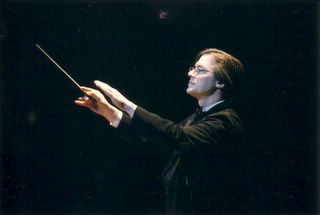
The director of the ensemble, a conductor well known throughout Europe, was certainly an imposing figure. A charismatic bear of a man, he stood out in the crowd long before we were introduced. Our early communications with him showed him to be someone who was open to suggestions but would not relinquish his entitlement to the final word. On arrival he was strictly business and immediately to the point. When the group moved to the auditorium for the rehearsal, he was clearly a driving force who pulled no punches. Afterward, when he came to talk to me about the program, I asked him how he was in Ukrainian. His only reply was laughter, but he warmed up a lot and became quite cordial. Fortunately, he spoke fluent English. He turned out to be a really great guy.

There was a certain amount of tension during the rehearsal and preparations; the ensemble had been on a regular concert tour, not an educational one. Their appearance at our school was a new and unexpected experience for them, and in many ways it was a bit awkward. Mssr. Maestro Ogawa had also stuck something of his own into the middle of the program, and that required some literally last-minute rehearsal of some challenging material. They were competent professionals, however, so we got it all worked out.

During the rehearsal, as I ran around like a kurcha with its holova cut off tidying up loose ends, I couldn't help noticing the man with the briefcase and dark glasses hovering around in the shadows. At one point he sat down in the back of the hall and cleared his throat loudly, whereupon the conductor glanced back at him with what looked like anxiety in his eyes. I'm sure the guy was probably a tour agent or something, but he sure conjured up images of Cold War stereotypes not to mention Mafia Wars.

The morning performance was for the junior high school. The program kicked off with an excellent rendition of Mozart's Eine Kleine Nachtmusik. This was followed by an introduction of the individual instruments with a solo performed on each, accompanied by my (totally ad-libbed) Japanese explanations. Ye Olde Academy alumnus Yoichi Hembo, now both a professional musician and a teacher, was then called to the stage to play Vivaldi's Concerto for Sopranino Recorder accompanied by the Kiev Philharmonic string ensemble. It's a challenging piece that would normally require weeks of rehearsal rather than fifteen minutes, and it's a testimony to the competence and professionalism of the musicians that they were able to pull it off as well as they did. That was followed by a ten-minute intermission, after which the string ensemble finished off with Tchaikowsky's famous Serenade. After a bit more ad-libbing on my part in Japanese with a few phrases of Ukrainian thrown in for effect, the ensemble played an encore, a beautiful tune called simply, "Melody" (I don't recall the composer.). Amazingly, the students, including that notorious 9th grade rabble, were good as gold through the whole thing and gave a warm round of applause.

Lunchtime was a bit of a surprise. It had always been a tradition for Mr. Ogawa and I to have lunch together with the visiting musicians. Not so this time. We had ordered boxed lunches for all of us, but the Japanese tour guide accompanying the ensemble brought our share back to the music office and said the Ukrainians wanted to eat by themselves, the conductor in his own private room. Once again I found Cold War stereotypes floating through my mind, and I kept having to slap my subconscious self.

Although the program was the same, the afternoon performance for the senior high school was a bit of a different animal. For one thing, the auditorium was quite a bit hotter. For another, since the performers were all more relaxed, they didn't try quite as hard, meaning a bit of a loss of energy. The audience also wasn't as cooperative; not only were members of the notorious 11th grade class a bit noisy and uncooperative, but one of the teachers got up, left the hall, and came back in again twice while a performance was in progress. (The conductor later complained about that teacher...who responded to the subsequent scolding that he was being unfairly victimized.) The senior high students also weren't nearly so generous with their applause as the junior high kids had been. There was also the matter of the maintenance person who decided to start using power tools during a soft movement of Tchaikowsky's Serenade. Nonetheless, it was still a good performance and a generally positive experience.

Visiting music groups in the past usually followed (or preceded) their performance with some kind of mixer event, e.g. signing autographs, offering instruction to members of our music club, and so on. Not this time. After the Kiev National Philharmonic string ensemble was done with their stage show, they gathered their stuff together and headed out to their bus immediately with hardly another word. To be fair, though, when a couple of our music club members came into the hallway and greeted members of the Kiev ensemble that played the same instruments, the latter seemed amazed, even touched by the contact. They were even more surprised when I led a group of eager students out to their bus to see them off. It was clear that the Ukrainian musicians simply weren't accustomed to that sort of thing. To underscore that point, the conductor came over to us and cheerfully asked if we were their fan club. The students, who had seemed a bit disappointed at the lack of acknowledgment, were delighted.

Finally, before he boarded the bus, the conductor came over to me, shook my hand, and said with a hearty laugh, "Now that you're learning all the languages, including Ukrainian, you need a bigger job!" I'd say that was quite a compliment! But actually, the job I have right now seems plenty big enough, and it's still growing. Heaven only knows what part of the world I'll be touching on next! :)

Labels: , , ,

Sunday, December 28, 2008

Fanfare for an Uncommon Orchestra

I've left for and come back from my one and only bit of work this winter vacation. It was the 2008 All-Japan Selected High School Orchestra Festival (technical but not particularly musical fanfare). This has been a more or less annual duty for me since the first time I accompanied the Ye Olde Academy orchestra there back in 1998. Back then it was a day-and-a-half event involving a total of eighteen orchestras. This year it stretched across three full days and included fifty-six orchestras split into three blocks. (Yes, it has grown a bit.) Since I don't personally direct our school orchestra, my main job on this outing is mainly to help chaperon the several dozen kids that fill its roster as well as serve as a "gopher" (go pher this, go pher that...) for Mssr. Maestro Ogawa. It's a duty that I always enjoy...at least for the most part.

Part One - The Rant
I'll start out by getting the venting out of the way.
  • When this event was first conceived and held back in 1996, one of its main overseers was a member of the Imperial Family, and they were very serious about the "Selected" part of the title. In other words, they didn't "select" just any high school orchestra to participate. Receiving an invitation meant that you had been noticed and judged worthy. Our orchestra was first called in the second time the event was held, i.e. in 1997, and we saw it as a tremendous honor. All of the participating orchestras were very talented and capable, and it really meant a lot to us to be considered worthy enough to be counted among them. However, since the mid 2000s the event has been fully in the hands of the Japan Youth Orchestra Federation, and they are dominated by a very left-wing, "we're all equal, we're all beautiful, we're all happy," philosophy. In other words, there are no longer any standards; they invite whoever seems to be able and willing to come. That means that, while there are still many truly impressive high school orchestras on the (steadily bloating) program, it also means there are some groups that get up there and just make fools of themselves. Yes, I know - they're all proud to have their turn in the spotlight, and they're all doing the best with what they have, but it's still sad to see kids who flat out don't know how to play their instruments get up in front of a very demanding audience, try to play a tune that's clearly over their heads, and wind up being laughed at. Frankly, I feel sorry for them. Left-leaning though I tend to be in the political arena, there are times when I think forced equality is a bad idea. This is one of them.
  • As if to underscore the point, during the opening ceremony one of the reps from the Japan Youth Orchestra Federation got up on stage and lectured everybody as to how to fill out the comment cards they're supposed to send to all the other orchestras. "Don't write any negative or critical comments," he said. "They just make people unhappy. Write only happy, encouraging comments!" Heck, if you're going to be that PC, why have the kids write anything at all? Just give them all standardized ink stamps that say, "Nice job!" That way EVERYONE is equal, EVERYONE is beautiful, EVERYONE is happy! (RETCH!)(No, I'm not a believer in PC.)
  • The PC stupidity also wrecked extended to the "selective ensemble" performances. They used to be purely "participation by audition only", i.e. the creme de la creme, and they were always excellent and a delight to listen to. Again, starting a few years ago when the JYOF assumed full control, it was taken over by that same "everyone is equal" philosophy. In other words, every participating orchestra was given an equal share, with the parts each filled decided by random drawing. I think you can guess the result. There were some very talented kids up there. There were also some poor souls that were totally ill-suited for the tough tunes they were called upon to play and probably had no business trying. You know the old adage, "The road to ruin is paved with good intentions"? That pretty much sums it up.
  • The Nippon Seinenkan, the culture/convention center where they hold this event every year, was barely big enough for everybody back when there were only 18 orchestras participating. 56? Forget it. Our reserved section in the hall (which kept getting moved and resized as the event progressed) didn't have enough seats for everyone, so I wound up spending much if not most of the time either sitting in the lobby listening to the performances via the PA or parked on a bench over in the convention center section reading a book. Meanwhile, it was so packed that getting from place to place was always a problem. We were also rudely booted out of our assigned luggage storage area halfway through the second day so another school could use it, meaning we had to tote our bags and cases with us for several hours. No, it wasn't fun.


Fire Emergent Phone
What the Sam Hill (whoever the hell he was) is a "fire emergent phone"??!? Cell phone pic taken at the Nihon Seinenkan.

Part Two - The Cheer
Don't get me wrong; there are usually a lot of good things about this event, and this year was no exception.
  • The Ye Olde Academy orchestra continued its tradition of audacity this year. We've always had a tendency to play tunes most school orchestras don't and avoid those that they do. Our program this year was a salute to Aaron Copland and included two numbers. The first was "Fanfare for the Common Man", and it was performed by only our brass and percussion sections with the rest of the orchestra waiting offstage. Considering the kids had to play the thing cold after a half-hour wait backstage, I was really worried. Yes, the opening trumpet blare skidded a bit and it took a bit for the horns to get into gear, but once they got into the groove they sounded great. The one that really stole the show, however, was the 7th grade girl (in bright red) who conducted. Once that was done, the full orchestra came in, Mssr. Maestro Ogawa took the baton, and they performed El Salon Mexico, which is a very tricky and demanding piece to play, but the kids pulled it off nicely with some brilliant solo work from the trumpet, clarinet, bassoon, and cello sections. The percussion section also wowed with the interesting array of instruments and toys they brought out. All in all, it wasn't a perfect performance, but it was still a very good one and earned us lots of praise.
  • Speaking of which, it is always welcome and meaningful to get both positive feedback and useful, constructive comments from orchestras which are clearly more capable than us, particularly those that are fortunate enough (grr...) to have elite music major programs (which is generally why they are more capable than us). It is always an honor and a pleasure to be compared with such power groups, to be ranked among them, and even to be considered by them to be on their level. Considering what we have had to work with over the years, I'd say Mssr. Maestro Ogawa and his various trainer friends, not to mention the kids themselves, have accomplished a lot...and the fact that they enjoy doing it rather than treat it as a duty says a lot.
  • On the other hand, at the risk of sounding arrogant (but hey...I'm a bit spoiled in this respect, right?), it's always extremely amusing when members of orchestras which are clearly NOT at our level try to lecture us as to how we should run our program. "You sit too deeply in your chairs," ranted a member of one VERY weak orchestra in his/her comment card. "Sitting fully erect on the edge of your chair to keep your upper body free is one of the most basic rules of music! I also saw a couple of violins whose bowing was out of sync! And one of your doublebasses was holding her instrument funny! If you can't even master such fundamentals, you have no business performing on stage!" Um...why don't we talk about the log in YOUR eye while we're at it, huh?
  • The orchestra that followed us, a group from a very reputable school (with an elite music major course)(grr...) in faraway Fukuoka making its first-ever appearance here, was awesome. They more or less blew us away with an excellent combination of Verdi and Star Wars. But we were fortunate in that we shared our storage room and hotel with them, and they were a great bunch. I have found that it is often (though definitely not always) the case that the best orchestras, the ones that are really good, quite often have good attitudes to go with their abilities, whereas it's the pretentious ones that tend to be insufferable snobs. That worries me, however, because I've noticed our own kids tend to be rather cold...
  • Our 11th graders did their best to manage things efficiently and effectively. I'd say they did a good job in terms of showing leadership, teamwork, and responsibility. I'd say they showed some flaws, however, when it came to coming up with a plan and sticking to it, because they didn't. What they wound up doing was quite often very different from what they'd said, and that did lead to some confusion. It was a good thing that they were attentive enough to avoid disaster, because we did come close on a few occasions. But at least they really were doing their best, i.e. no one was shirking his or her responsibility.
  • Once again the teachers and alums got together for dinner at the usual French restaurant in Shinjuku (a tradition for the past few years). I always enjoy going there, though I have to say I didn't really enjoy squabbling with Mssr. Maestro Ogawa over matters concerning the Kashima Philharmonic. Perhaps it was inevitable, especially considering the position I've wound up in, but I'd still rather it didn't happen.
  • I got sick of sitting out in the lobby (i.e. my butt was getting sore), so I went for a walk during the last hour of performances (missing some of the worst, I was later told). I was actually looking for a coffee shop such as Starbucks, but I didn't find any. What I did find was an interesting shopping strip with several boutiques, restaurants to keep in mind, and some novelty shops that I wish I'd had more time to check out. I also enjoyed looking at the Christmas light displays that were still out and in full swing. Ironically, there was a new Starbucks at the highway rest area we stopped at on the way home, so I was able to get a grande-size mocha.
  • Now that that's over, I have a full week free of work or anything other than family business. Whatever am I going to do with myself? :-)

Labels: , , ,

Sunday, July 13, 2008

Whistlin' Dixie (Well...Tootling it, at least!)

A number of years ago I was asked to sit in with a Dixieland combo. The leader, who played sousaphone (a type of tuba that is round so as to sit on the shoulders) was an American who was with the JET Program, the government project that was responsible for bringing me to the Land of the Rising Sun in the first place. The lead trumpet player, Mr. K, is a music teacher in my area and a musician I've worked with off and on for years. The clarinetist was the father of one of my students at Ye Olde Academy at the time. (There were a couple of other members, but they were people I hadn't met before.) I was asked to play tenor saxophone. After that first gig together, which was at an International Fellowship event in Kashima, I was invited to perform with them more regularly. My schedule made it hard for me to participate very often, but I did manage to appear with them in a number of gigs, usually at festival events. With a constantly-changing lineup, we played at a number of places including a few festival halls, the Ibaraki Prefecture government building, and a culture center down in Yokohama.

It was a lot of fun, and I really enjoyed it, but I have to admit there was a small degree of frustration on my part. The sousaphone player and Mr. K knew what they were doing, obviously, but among the various other members that came and went (usually based on who was available at the time) there was an awful lot of WAWD (What Are We Doing) syndrome, i.e. they were more or less lost. If we played a tune that had a full arrangement things went okay, but if we only had the melody and chord changes, which is what jazz is supposed to be about anyway, the performance had a bad habit of devolving into a chaotic mass of noise, no one paying any attention to what the others were doing (or what the chord changes were, for that matter). That's fine for a while, but I admit it often got a bit irritating, especially since the tenor sax plays more of a supporting role in a Dixieland combo. I continued to play with the combo as much as I could for a while, but eventually a combination of an increasingly complicated schedule and declining motivation on my part led to my participating less and less. Eventually the invitations to play stopped coming altogether.

Cut to a week ago. I suddenly got a phone call out of the blue inviting me to play with the combo again. It was to be at a beer garden event at Kashima Central Hotel, where I had stayed to help out with the Garfield High School orchestra only a couple of weeks before. It had been at least a couple of years since I'd played with the combo. Come to think of it, it had been quite a while since I'd done ANY kind of real jazz performance in front of an audience. There were some nagging doubts. I was happy with my performance with the Kashima Philharmonic at the Kashima Music Festival in June, but there's a big difference between "Bolero" and Dixieland Jazz. I was seriously worried about mold and rust, so I wasn't sure about it, but I went ahead and said yes anyway. Considering all the pressure in my life at the time, I figured it would be a welcome distraction.

The day of the performance came, and yet another surprising phone call came. I admit that, for a number of reasons (including fear of rust), I was starting to feel inclined to bow out of the gig, but it turned out they had a problem. The clarinetist who had been a regular member before had long since dropped out, and the "in training" replacement had suddenly phoned in to announce his absence. They asked me if I could play clarinet instead of sax. Considering the importance of clarinet in a Dixieland band, I didn't want to let them down, but I felt even more pressured even though clarinet is (theoretically at least) my #1 instrument. I went for it.

I'm glad I did, too, because that was probably the most fun I'd had on stage in YEARS! Yes, there was some rust in my fingers, but I managed to work the worst of it out. One of the characteristics of Dixieland is that the tunes are simple but fun, i.e. none of the really obtuse, rapid chord changes you find in modern jazz. I was able to relax and get into it. My horn was responding really well, and once I was fully in the groove I was able to cut loose and wail like there was no tomorrow. Unlike the tenor sax, the clarinet in a Dixieland band has more authority and therefore more right to do what he wants when he wants. I milked that for as much as it was worth while still trying not to step on too many toes. What was really fun was when Mr. K and I started trading twos and fours and finally jamming together (i.e. me improvising a countermelody to his improvised melody), something I was never allowed to do on tenor saxophone. The second trumpet player and I also had fun improvising backing rhythms behind other solos, something else I'd never been able to do with that group before. I also had some fun singing vocals on a few tunes. The leader of the group on his sousaphone eagerly drew the tunes out so we could keep the energy going, giving us the signal to go back to the melody when it was time to quit. All in all, it was a total blast, and I'm very glad I did it.

The audience in the beer garden, most of whom were there by reservation, gave us a warm (if comfortably inebriated) response. It also turned out that Mr. K and I knew some of them...and were known by several more...because they were people involved with Kashima's music and/or festival scene. We were also photographed for the local newspaper.

I guess there's nothing wrong with a little image-dropping, eh? Especially when it's SO MUCH FUN?

After the gig I was told that I'd be hearing from them soon. I hope so. I'd really like to do something like this again!

****
An (unpleasant) update

After coming home from the Dixieland gig with my feelings (and my ego) all nicely pumped up, I was given some very bad news. The doctors had had a look at my mother-in-law earlier that day. The prognosis was about as bad as it could possibly get. The doctor recommended that we have anyone wanting to see her one last time come within the next week. After that there are no guarantees. Ironically, she seemed more chipper when we went to visit her today, but the doctor says it won't last long. It appears that her fight is pretty much over.

Now I'm on the verge of learning about an area of Japanese culture that is both very important and full of very old traditions. It's also an area that I know almost nothing about. Frankly speaking, I'm not looking forward to the opportunity.

Labels: , ,

Sunday, June 29, 2008

SECs and the City, Part Q

Once upon a time I did a post on this blog in which I talked about SECs, or Stupid English Catchphrases. I'm talking about all those wonderful English phrases used by marketers and promoters here in Japan to make their products look classy, but which were concocted with a sadly inadequate understanding of the language. The results can range from bizarre to flat out hilarious.

For example, take the TV commercial I saw last night.

In the ad, a number of different people from different walks of life (businessman, office lady, housewife, etc.) all look square at the camera and say (in English):

"I am a..."

After a whole string of these, they mention the name of the loan bank which is being advertised:

"Dikku" (pronounced "Dick")!

I guess we are to assume all those people are saying, "I am a DIKKU!!!"

I seriously have to wonder if some native English-speaking consultant somewhere is laughing out loud while counting all the yen paid to him by Dikku for his creative input. That's just too good to be a coincidence. And speaking of dikkus...

Yesterday (June 28th) saw the largest music-related event in the history of Kashima, the Kashima Music Fest (hugely budgeted fanfare). It wasn't intended to be quite so huge, but it was.

It started out innocently enough. Some months ago the music club at Ye Olde Academy got an e-mail from the director of the Garfield H.S. orchestra in the U.S. saying they were coming on a tour of Japan. They had came to Kashima before, namely a few years ago, and we had staged a joint performance/reception at our school. (I posted about it on this blog, but I won't link it just in case I'm still being spied on.) We still had fond memories of that event, and we'd been hoping to do it again. Now the Garfield orchestra was offering just such an opportunity. However, true to form, Mssr. Maestro Ogawa wasn't one to leave things as they were.

The orchestra at Ye Olde Academy is currently in maintenance mode after the loss of several key players to graduation with few truly viable replacements. Figuring they'd be in no condition to work next to the Garfield orchestra (which is definitely a high-class project), Mssr. Maestro Ogawa decided to involve the Kashima Philharmonic as well. Then he got to thinking (ominous diminished 7th chord). Last time the Garfield orchestra came, we held our concert event at the school auditorium, but with a full orchestra on the floor it can only hold a few hundred spectators. The Kashima Workers' Culture Hall is always a possibility, but even it can only seat around 750 people. Mr. Ogawa figured we wouldn't be doing the Garfield orchestra justice unless we could get at least a couple thousand into the venue. But was there any such place anywhere nearby? Yes, there was. The Kashima Sports Center, fully completed in 2002, was designed to seat 2,002 (Yes, you read that right. It's because it commemorates the 2002 FIFA World Cup, in which Kashima was one of the venues) in its main arena, which also happens to have a stage. Problem solved...

...NOT. Unfortunately, the manager of the KSC was extremely anal about it. He said basically, "I am a dikku!" "This facility is only for sports or sport-related events. We won't agree to its use for any other purpose without a specific directive from the City of Kashima." Well, Mr. Ogawa went to City Hall to get just that. Not very optimistic about it, he started resigning himself to using the Kashima Workers' Culture Hall instead, but then he got a phone call from the Mayor...which turned out to be more than he'd bargained for. Basically, the Mayor said, "SURE you can use the Sports Center for this event! And while you're at it..."

And thus the Kashima Music Fest was born. In addition to the Garfield and Ye Olde Academy orchestras and Kashima Philharmonic, it included all the junior high bands in Kashima, all the senior high bands in the Eastern District of Ibaraki Prefecture, a senior high Taiko Drum Troupe, a local ballet troupe, and three community choirs. It also involved a nightmare of organization, logistical planning, recruiting, promotion, rehearsal, and ticket sales, nearly all of which was dumped directly into Mr. Ogawa's lap...and subsequently delegated to the executive committee of the Kashima Philharmonic! The fact that we had never tried to pull off anything even remotely like this before was bad enough...coupled with an untried venue. To make the whole thing worth it, we put together a performance itinerary which was very ambitious in scale, putting pressure on the many performers and directors alike. We (Read "I") also had the complicated business of trying to work out various issues with the Garfield orchestra, which had enough problems of its own, without putting undue pressure on them. In the end the sheer scale of the thing was intimidating to say the least. There were just SO many things that could go totally wrong at the least provocation! By the time the Garfield buses rolled in on the evening of the 27th for our first and only full rehearsal together, many if not most of us were nursing ulcers and scars from torn hair.

Anyway, without going into all the rehearsal stuff (or the fact that I had to be responsible for five different instruments), I'll go directly to the event itself.

There had been some concern about the weather, but the 28th turned out to be nice...if a bit hot and muggy. After all the massive expenditures, we knew we had to sell at least 1500 tickets to break even. Thankfully, almost all the 2002 tickets were sold, and about 1800 people showed up. Unfortunately, the KSC management (still being a...dikku) insisted on blocking off part of the stadium parking lot and wouldn't let us use the air conditioners, citing worries of circuit breaker capacity. (They told us later...while the event was in progress...that they had special high-capacity power connections for special events...for an additional fee. Gee, thanks...dikku!) The result? A hideous traffic jam followed by a main arena that quickly reached oven temperature. That didn't stop the overwhelming majority of the audience from staying for the entire, three-hour marathon!

It all started with the junior high mass band, consisting of the concert bands of Ye Olde Academy (junior high) and two of the Kashima public junior highs. Three other junior high bands in town had hoped to be there, but a ridiculous gaffe on the part of City Hall had led the principals of those three schools to intervene and pull them out after rehearsals had already started. I didn't get to hear their final performance, but they made a valiant effort. They were followed by a Taiko Drum (traditional Japanese percussion) troupe from Kashimanada High School, which provided an exciting break from the usual fare. After that was the senior high mass band, which was made up of the concert bands of all twelve senior high schools, public and private, in the Eastern District of Ibaraki. The fact that the total number of players was only about 70 shows in no uncertain terms the sad state of high school music in this part of Ibaraki. Some of those bands have fewer than a dozen members each. They worked hard, and their performance was quite good.

Next was the joint Kashima Philharmonic/Ye Olde Academy orchestra performance. We started out playing a sort of Straussian 2001: A Space Odyssey medley including the intro from Also Sprach Zarathustra and "The Beautiful Blue Danube" (each by a different Strauss brother). This was followed by a suite from "Pirates of the Caribbean", which is always a blast to play. We then did some quick seating changes and started the highlight of our set: Ravel's "Bolero".

"Bolero" is quite a fascinating piece. It is repetitious as can be, repeating the same bass line more than a hundred times and including a mere three melodic themes. However, it is full of surprises. Conventional instruments are used in unconventional ways. Unconventional instruments are used in conventional ways. And all along, that theme just keeps building, building, building as if the sun is rising and a city is coming to life. But then, just as it seems like that theme is arriving at a glorious climax, it suddenly turns into a screeching, grating cacophony and ends in one of the nastiest closing hooks in the history of classical music. It sounds easy, but it's not. Actually, "brutal" would be an appropriate term. It requires some extremely skilled musicianship, both from its various, taxing solos and the steady, controlled rhythm that forms the piece in the first place. I had always wanted to play it. I had always been rebuffed. This time not only did we do it, but I had TWO solos (one on Eb clarinet, another on tenor sax)!

Not surprisingly, we had ringers in our ranks; each of the string sections plus the horn, trumpet, trombone, and oboe sections had one professional extra each. Most of them are our regular guest clinicians, so we know and work with them very well. The trombone ringer, however, was someone Mr. Ogawa came up with through contacts, and he was definitely a...dikku. When members of our orchestra tried to greet or thank him for his help he responded by not responding or even acknowledging their existence. Instead of setting up, warming up, or attending the announcement assemblies and march to the backstage door, he spent the entire time leading up to our performance in the concert hall sitting in one of the audience seats typing text messages on his cell phone. We were not impressed.

"Bolero" was the piece we had worried about the most because it is so demanding and because there had been so many problems in rehearsal. I myself wasn't in good shape at all when we rehearsed on the 27th. During the main performance, however, fortune smiled on us. We kept it together, held the tempo, and all the solos and ensembles came in properly. As for me, I felt really good during "2001" and "Pirates", so I just relaxed and got into my solos. I really felt more in the groove than I usually do onstage. My Eb clarinet solo felt really good. The sax solo felt even better. I have yet to listen to the recording (which may yet yield unpleasant surprises), but it really seemed to be a shining moment for us, and the thunderous applause we got from the biggest audience we'd ever faced made my throat seize up for an instant. Definitely a shining moment.

Come to think of it, the only low point was the trombone solo. The ringer sounded great in rehearsal, but he was full of holes during the performance. Our own trombonist probably could have done as well without costing as much. What a...dikku!

Garfield was up next. Unfortunately, I had to haul four instruments (A clarinet, Bb clarinet, Eb clarinet, tenor sax plus their stands) back to our practice room and get ready for the final production number, so I wasn't able to hear much of their performance. They're one of the top school orchestras in the U.S., though, and what I heard of them was top notch. I'm sure they did great.

Then came the ultimate performance spectacle. The final set was the Garfield orchestra together with the Ye Olde Academy orchestra and Kashima Philharmonic. But that wasn't all. We brought out the massed choir and ballet troupe. What did we play? The Triumphal March from Verdi's Aida. Aida is an opera to end all operas simply because it calls for such a massive scale. This one selection is no different. A challenging and dramatic tune on its own, with the added choir and ballet it was nothing short of amazing. It was also a daunting undertaking. We rehearsed it with the choir only four times. We rehearsed it together with the ballet troupe and the Garfield orchestra only twice (the evening of the 27th and the morning of the 28th). Anyone with any common sense would call us insane to attempt something like this with nearly all amateur performers! I wish you could've seen it! The Garfield kids are wonderfully competent, so they had no trouble adjusting to Mr. Ogawa's interpretation of the piece, which was very different from what they'd rehearsed at home. The choirs were also far more on the ball than we'd feared, and they stayed right with us powerfully and, most importantly, in tune. I couldn't see much of the ballerinas, who were dancing behind us, but they gave a lot of added spark to the piece. Those glorious brass-and-choir fanfares (I say partly because they mainly consist of the word "Gloria") really rang out in that sports arena. So did the applause. I could see some members wiping their eyes. We've pulled off some miracles before (like...Beethoven's 7th last winter?) but nothing like this. History was made in Kashima.

Now if only the ballet troupe had come out for the second curtain call along with the rest of us...

We played two encores. The first was J.P. Sousa's "Stars and Stripes Forever" under the baton of the director of the Garfield H.S. orchestra...and played very much American style! :) This was followed by the soft, emotional piece "Sen no Kaze ni Natte" (Become a Thousand Winds...aka "Don't Weep By My Grave") sung by the choir to our orchestral accompaniment (arranged by this moody minstrel). Then it ended...and we all heaved a huge, collective sigh of relief.

I went to the reception for the Garfield orchestra afterward, but I just felt drained. The traditional after-concert party for the Kashima Philharmonic was also sparse and kind of melancholy...though Mr. Ogawa was happy and had only good comments (which is EXTREMELY unusual!). Then I was off to Kashima Central Hotel, where the Garfield group was staying, to help out as an additional interpreter/gopher, but I think I was too burned out to be of much use. (I won't complain about the complimentary room and breakfast, though.) Now the Garfield group is on its way back to Seattle after having finished their latest Japan tour with a bang (or a glorious fanfare, take your pick). At Ye Olde Academy all the music rooms are quiet and dark.
I'm back home thankful for the rest. As for Mr. Ogawa, I'm sure he's enjoying a much-deserved bottle of wine.

Tomorrow is Monday...

Labels: ,

Wednesday, June 04, 2008

The First Attempt

I've finally done it! I've completed my first song using my new all-digital studio setup!

If you've been keeping up with this blog and/or my Minstrel's Muse site, you know that I bought a Roland Sonic Cell and Edirol (Cakewalk) SONAR 7 Studio Edition a few months ago as my birthday present to myself this year. I fiddled with them a bit while completing my Blog Blunder album to try to get to know them, but I still relied on my 8-track recorder, studio effectors, and stereo CD burner to produce the final product. This time I did it all straight to the computer and made the audio file straight from the computer with nothing in between!

It certainly took long enough. It was quite some doing just getting the first track done, since there were so many settings I had to get right first. Once I got past that first hurdle (and read the tutorials carefully) things got much easier. There were only a few screwups, none of them seriously affecting the outcome, but learning as I go is the whole reason I'm doing this now! Besides, I'm still only just barely scratching the surface as far as what this gear can do!

Anyway, my first new product on the new setup is a song called "Perspective". Listen and tell me what you think! (Yes, I know it's a bit rough, but hey...this was intended to be an experiment and a lesson, a first step if you will, rather than a serious project. I'll get funky once I have it all down. Maybe then I can finish those arrangements for Jeff...)

Labels: , ,

Tuesday, November 27, 2007

Weekend Concerto in Gee...MAJOR!!!!

What a weekend THAT was...

It was a hectic weekend, a hellish weekend, a booked up and socked full weekend, a weekend to remember, a weekend never to be forgotten even if it wants to.

It was a weekend of music...and not much else!

The fun actually started months ago. Last spring I was invited once again to have the Flying Eggheads jazz big band participate in the Kashima Seaside Jazz Festival, which was coming into its fourth year. At the time its scheduled date, November 24, was wide open. The only other important music-related event even close to that day was the district small ensemble contest, but it was scheduled for the 17th, one week earlier. That was no problem, so I went ahead and gave my approval. As always, the KSJ Friends (the official supporters' group for the Kashima Seaside Jazz Festival) didn't waste any time. By the time summer ended they already had the concert billing publicized and were already selling tickets. In other words, our participation was set in stone.

In late September it was announced that the ensemble contest had been delayed one week. That put it on the same day as the Festival. That posed a dilemma. You see, the ensemble contest is one of the more important events of the year. It was a given that several members of the Flying Eggheads wanted to compete, and failure to do so could reflect very badly on our music department. That meant we had to do both events somehow.

Another problem was rehearsal time. Between the orchestra's preparations for the All-Japan Selected Youth Orchestra Festival in December, preparations on the part of most of our string section to help with the Kashima Philharmonic concert in December, a select group practicing for the Amateur Chamber music Festival in November, a few students practicing for a solo contest, and various other small performances here and there, it was hard for the kids to squeeze in practice time for their ensembles, let alone rehearse with the Flying Eggheads. It was a planning and logistical nightmare. To make matters worse, the week before the 24th was dead week (i.e. the week before an exam period). That meant all afterschool club activities were suspended. I managed to get special permission to practice, but the administration only agreed to let us have two hours that week for the entire music department, i.e. both the Flying Eggheads and the ensembles had to share those same two hours. Considering many if not most of the ensemble members were also Eggheads, it meant we had a serious problem.

Friday the 23rd was a national holiday, but it was NOT a holiday. One of those two allowed rehearsal hours was that morning, so I rehearsed with the Eggheads for half an hour and gave the kids the other half for their ensembles. Then, in the afternoon, I had to run across the street to the new Kashima City Cultural Center to rehearse with the Kashima Philharmonic for almost five hours. Our pro guest conductor wasn't there that day, so I had to conduct those five hours. Believe me, I was wiped out.

Then came the 24th, and the schedule went something like this:
  • 8:00 a.m. - Mr. Ogawa and Mr. Karatsu arrived at the Kamisu Culture Center (henceforth KCC), venue for the district small ensemble contest, together with some students who were to be working as staff there.
  • 8:30 a.m. - Mr. Ogawa returned to Ye Olde Academy just as I arrived there.
  • 9:00 a.m. - I borrowed one of the school vans. Together with Mr. Ogawa in his van, we transported three ensembles to the KCC for the district small ensemble contest. On the way, however, I took a detour to the Kashima Workers' Culture Hall (henceforth KWCH), venue for the Kashima Seaside Jazz Festival, to drop off a couple of the Eggheads members. I wound up being delayed there, and the ensemble I was transporting arrived at the KCC slightly late for their entry.
  • 10:00 a.m. - Arriving back at Ye Olde Academy, I set to work hauling the band's gear to the KWCH. At first I had no help at all. Then, on the second trip, I had one student helping me. Then there were more. Finally, I switched from hauling gear to hauling personnel. Around this time Mr. Ogawa returned and shared the busing load.
  • 12:00 a.m. - After a quick lunch and a little warming up, I set out for the KCC to pick up some students and bring them back to Kashima. I was about halfway there when I got a phone message telling me to return to the KWCH at once. Apparently the district small ensemble contest was running late, meaning our students there were going to be delayed, so Mr. Karatsu was going to run them back instead of me.
  • 12:50 a.m. - The students coming back from Kamisu arrived at the KWCH. We changed, prepped, and started warming up.
  • 1:30 p.m. - The Flying Eggheads were called to standby backstage. Fortunately, the stage manager and crew were professionals who really knew their stuff. Setup went smoothly and quickly. Downbeat started right on time at 1:50. We were forced to perform cold (i.e. no sound check), but the sound was fine. The kids were nervous at first, and many if not most of the soloists that day weren't really in the groove, but the band itself turned in a fairly solid performance. (I say "fairly solid" because I know we could have done better, but considering where we were and what we were doing, the kids were responding well to the pressure. I was only disappointed with some of the solos.) We had been given a 40-minute performance slot, but for a whole bunch of reasons I trimmed it down to about 20 minutes worth of performance coupled with around ten minutes of me gabbing. The audience response was great, so I guess it was alright. After our performance was over, I was given the obligatory interview (and I hammed it up, of course). Then we dashed out as fast as we could go.
  • 2:30 p.m. - Mr. Ogawa loaded the Flying Eggheads members who were in the brass ensemble into his van and dashed off to KCC. Actually, we were very lucky; the HQ of the district small ensemble contest had decided in all their generosity to swap out their time slot. Otherwise they never would have made it. Even so, I was really worried. The kids looked both worn out and stressed out. Meanwhile, I got started shuttling back and forth between the KWCH and Ye Olde Academy hauling the band's gear and members.
  • 4:30 p.m. - Once the gear and most of the students were back, I loaded up the members of the saxophone ensemble (all Eggheads, of course) and took them back to KCC so they could catch the final awards assembly for the district small ensemble contest. I decided to stay and watch it myself to show my support for the kids that had given so much time and effort to both events.
  • 5:45 p.m. - The awards assembly started 15-minutes behind schedule, but the results were wonderful. All three of our senior high ensembles not only got top-rank awards but were selected to represent our district in the Prefectural Championship next month. The same was true of two of our three junior high ensembles. If that third JH ensemble (ironically the most senior of the three) hadn't flopped it would have been a sweep for our school. I was especially happy because ALL of the ensembles including Flying Eggheads members made it. Those kids are truly amazing.
  • 6:30 p.m. - I made it back to the KWCH for the closing ceremony of the Kashima Seaside Jazz Festival. Those are always fun because the supporters' club always puts together some kind of impromptu final performance. Every year they have asked me to perform, twice playing clarinet solos in the tune "Sing, Sing, Sing" and once playing a clarinet duet with a professional Dixieland performer (a wonderful if humbling experience!). This year I hadn't heard anything, but I had brought my alto sax just in case. So when they said they wanted me to join the performance and I agreed...I was handed a cowbell and asked to dance. You see, this year's theme was "Latin & Jazz", so we did a samba number with everyone shaking or clanking something while dancing and carrying on. The only problem was that they had only three wind players playing the actual tune, and all that excited percussion wiped them out. It was a delightful bit of noisy chaos right up until the curtain dropped. That's when they started saying, "[Moody], you should have played your sax!" Well, hey....
  • 8:00 p.m. - I returned the school van after having clocked more than 100 km on its odometer,but the evening wasn't over yet. You see, I had received a surprising invitation a week or two before. Some musician friends of mine whom I hadn't seen in over a year were playing a blues gig at a local jazz pub and asked me to join them. I couldn't resist. (It also justified my having brought my sax along.) What a brilliant way to cap off the day! It was my first such gig in over a year, and it just felt great to be playing again! I barely knew (and sometimes didn't know at all) the tunes we did, but I listened, caught the key and the pattern, faked it, and went total balls-out on my solo breaks, often trading fours with one of the most awesome guitarists I've ever had the pleasure of working with. That coupled with the fact that I was remaking old acquaintances and making new ones while drinking draft Guinness (and me being someone who doesn't get out very often) made for one unforgettable evening! We jammed from 9:00 till 1:00 a.m.. I'd promised my wife I'd be home by 10:30. Needless to say, I wasn't. Fortunately, she was rather understanding.
That was Saturday the 24th. Sunday was easier in that I only had my conducting lesson, but it was a tough one (i.e. the final exam for that particular practice piece). Still, carried by all the good vibes of the day before, I really felt into it, and I got a compliment from the teacher, something I don't get very often.

Midterm exams at Ye Olde Academy started today...

Labels:

Sunday, March 25, 2007

The Future's So Bright...I Gotta Wear Shades

Well, it's that time of year again; time for me to be a doting band director again. Today was the day of the music club's Big Annual Concert (impressive fanfare), the event which caps off the school year and serves as a farewell to the 11th grade members. We followed more or less the same pattern as last year, holding a two-and-a-half-hour concert three days after the official last day of classes at Ye Olde Academy. Unfortunately, that also meant we had two and a half days of intensive rehearsal leading up to the performance, though this time we did everything we could (short of stun guns or chloroform) to try to get the kids to save their chops for the stage.

This year's 11th graders were definitely a unique bunch. To be honest, we were pretty worried about them when they first joined the music club as 7th graders. The fact that they were members of a problem class (the one that later drove me to throw a desk) pretty much said it all. They were terribly immature, excitable, spastic, noisy, out of control...annoying... They had a habit of neither listening nor doing what they were supposed to. In fact, if they did anything at all they tended to do it in a really half-hearted manner with lots of giggling. Yes, they were a frustrating and tiresome bunch, but Mr. Ogawa, Mr. Karatsu, and I still sensed potential in them. We did our best to engage them rather than dismiss them. We pushed them, gave them responsibilities and goals, and encouraged them to work together as a team. It wasn't easy to do. In fact, it was damned aggravating at times, but today we got to see the results of all our efforts.

Late in the afternoon on the day before the concert it started to rain. On the day of the concert we found ourselves with a raging storm. We were worried that the suddenly awful weather was going to torpedo our audience, but there really wasn't much to do about it. When the stage lights came on and the show started, the hall looked to be about half full...or half empty depending on how you look at it.

(That still isn't bad, but considering the Kashima Philharmonic has been playing to a packed house every time for the past three years...Mr. Ogawa and I have gotten a bit spoiled.)

Last year's Big Annual Concert (D major chord, A bass) kicked off with a brass fanfare. This year it was the strings' turn. A select senior high string ensemble mainly made up of the 11th grade string members marched out onto the dimly-lit stage and played J.S. Bach's "Praeludium pro Organ BWV552,1". Then they marched off again, I went on, and it was time for the Seishin Flying Eggheads (really funky fanfare). They were there to bring to a close what had undoubtedly been their most eventful year to date, and I'm not just talking about the busier-than-ever performance schedule!

Every year, at the Big Annual Concert (Amaj7 chord, diminished 9th), I do my best to let the 11th grade Eggheads decide our repertoire. I rarely intervene or veto a student's choice unless it is clearly mistaken. This year it seemed two such mistakes had been made. Our lead trombonist wanted to play a really difficult trombone solo feature version of "Misty". Our baritone saxophonist wanted to do Charlie Mingus' "Moanin'" with herself as the featured soloist through the whole piece. I told them they had to be joking. We'd last performed "Misty" in 2004 and "Moanin'" in 2005. On both those occasions we'd had outstanding individual players to cover the solo spots, and even they had found the pieces very difficult. They'd also been backed up by bands which were generally stronger than this year's group. As far as I was concerned, "Misty" and "Moanin'" were out of their league, so I vetoed the choices.

Well, compared with their predecessors, what the kids lacked in individual playing power they more than made up for with team spirit, dedication, motivation, and, above all, sheer audacity. They did something I would never have expected from a Japanese school band. They took matters into their own hands. They got "Misty" and "Moanin'" out of the music library and started practicing them on their own. They'd get whoever was available in the morning, during lunchbreaks, or after rehearsals, and they'd jam on one or both of those pieces as best they could. (I could hear them doing it, of course, but I pretended not to know.) Then, after a while, they asked me if they could "try" the pieces during a regular rehearsal. "Moanin'" was already almost down. "Misty", while still quite rough (it's a VERY hard tune for kids to play), was still more than good enough to qualify. Chuckling with amazement, I told the student captain to go ahead and put both tunes on the list.

The kids' inventiveness and courage didn't stop there, however. If anything, I'd spurred it on. During the two days of rehearsals leading up to the performance the 11th grade Eggheads kept coming at me either to ask permission to do something they'd just thought of or simply to warn me about it. I was amazed. We'd had motivated Flying Eggheads in the past, but nothing like this!

Okay, it's time for me to give my annual kudos. At the risk of getting in trouble (or sued), I'll say f*** the initials and give credit where it is due.

In the past, the Seishin Flying Eggheads had always opened their program with a fairly easy number so they'd have time to get over the jitters and get into the groove. This time we decided to take a risk and start on a high note. We kicked off the program with the original Weather Report version of "Birdland", a regular favorite of ours. The trumpet section managed NOT to splat their first note (a curse they'd had all year), and the kids pulled it off really well.

Our first 11th grade kudo for 2007 goes to Yumiko Sato, our enthusiastic bassist this year, who bought a Fender Jazz bass just for the occasion. She pulled off the thumb-slapping Jaco Pastorius break in the middle of "Birdland" better than any bassist we've had to date. Another kudo, perhaps the most surprising, goes to percussionist Masashi Okuta for the awesome conga solo he threw in right after that bass break. Entering our school as a 10th grader last year, he was a capable classical percussionist but had little experience with drums. He entered the Flying Eggheads, played drums on one tune, blew it badly, and quit immediately afterward. Then he came back a few months later, apologized, and asked if he could play percussion rather than drums. I asked him to play congas. He did a good job, but he always looked so damned somber. As it happened, during the rehearsals before today's concert Mr. Sakuma (our part-time soundman, occasional stage manager, and full-time bulldog) finally blew up at him, saying what could perhaps be best translated as, "Oh, come on! You look dull as snot! Spice it up! Live a little!" Well, guess what...he did! He was all over those congas, muting with his elbow, spinning his hands around, smiling, banging his head, and definitely looking totally unlike himself. It was brilliant! (When we watched the video of the performance afterward the whole music club including all our visiting alumni gave him a rousing, whooping ovation.)

After "Birdland" came to its rather abrupt climax, I walked off the stage, and Chiaki Ohshima launched into an extended piano solo, an improvised venture she'd come up with (and informed me about) only the night before. We'll probably miss that girl more than anyone else in this year's 11th grade group. She's a talented flautist, but it's mainly as a pianist that she has earned her marks. From the time she entered as a 7th grader she immediately started serving as an accompanist for all kinds of soloists including Mr. Ogawa and myself. Always battling health issues (apparently due to exhaustion, but she would never let on or let up), she nevertheless would never hesitate to help out when asked, and she provided on-the-spot accompaniment for my sax solos on many an occasion. She was also the loyal rehearsal pianist for the Kashima Philharmonic...and actually outperformed at least two of the guest players (both professionals) she was supposed to be emulating! Obviously a gifted classical player, she had a bit of trouble getting used to jazz in the beginning (as is often the case); as a 9th grader she actually came to me in tears and apologized after playing her first ad-libbed solo, which I thought had sounded fine (inspiring the song "Why These Tears?" on my Open Halls album). This year she seemed much more comfortable, and the little hooks and fills she started sticking in the breaks became a regular feature of this year's Flying Eggheads. Well, now she was in the spotlight by her own choice playing a lovely, little cadenza as a lead-in to the next number, "My Heart Will Go On".

That soulful (if a bit hackneyed) ballad was originally an alto sax feature, but I rearranged it so that lead alto saxophonist and this year's Flying Eggheads captain Hiroko Yamamoto traded off with lead trumpet (and best smiler) Ayaka Karumi. Throughout the year a lot rested on those two. Both rather timid souls, they were nowhere near the best we've ever had at their respective instruments, but Ms. Yamamoto was definitely our strongest jazz player this year, and Ms. Karumi did a lot to make a struggling trumpet section a very credible one (not to mention she played with an unforgettable, warm tone that always reminded me of Miles Davis).

Yumiko put away her electric bass, picked up her wood bass, and we went into swing mode with "It's Only a Paper Moon". It was the only new tune on this year's roster. We opened up the middle to a few solos including Sachie Kitami on tuba. Originally a euphonium player, she picked up tuba this year when our existing tuba player (a bit of a loser) suddenly quit (to no regrets). Sachie took to it immediately. However, she actually seemed more comfortable playing it up high...in the euphonium range! Unlike tuba players we've had in the past, she was totally comfortable standing up and playing a solo and really seemed to enjoy it, too.

Next was "Misty" (clench fists anxiously), featuring trombonist Chihiro Kubota (and a bit more of Chiaki on the piano). As a 7th grader, Chihiro was famous for the fact that she could never figure out her instrument. Even after having studied and practiced it for the better part of a year, she had to learn each piece one note at a time because she simply could not remember the slide positions. We were sure she'd give up and drop out. Not only did she stick with us till the end, but now she was playing a gorgeous and very difficult (and very high ) solo. She had enormous shoes to fill; in 2004 that tune was played by Hirohito Tanaka, by far the best lead trombonist ever to play in the Eggheads, while Chihiro played 3rd trombone. Now Tanaka was helping out backstage (his mouth hanging open with disbelief), and she was in the spotlight. No, she didn't play it quite as well as he had, but she still did an impressive job, more than enough to prove herself.

After "Misty" came to its final, major chord conclusion, I walked over behind the rhythm section. Baritone saxophonist Suzuka Narui immediately stood up and launched into the opening riff of "Moanin'". There was a bit of an uproar from the audience because all of the members (including me) had suddenly put on sunglasses! (It was Narui's idea...another surprise sprung on me the day before the concert!) Like most of Charlie Mingus' works, "Moanin'" is very artsy and hard to play effectively. It is essentially the art of noise, the sound of someone being overcome with either frustration or passion (or both). It starts out with that bluesy bari sax riff all alone. When it comes around again, a trombone and tuba play a quiet but bluesy countermelody. Then two saxes come in improvising together over it. Then two more instruments come in, then two more, and finally the original melody is buried in what can only be called total chaos...which suddenly resolves itself again. Not only does almost every member of the band have to ad-lib, but they have to make it thematic (i.e. melodic) improvisation which starts out solemn and gradually turns into frantic screaming. We first tried "Moanin'" as an encore back in 2001, and since the band had very little in the way of improv power we only played the first half, and I wrote solos for all the members. (It sucked!) In 2002 we tried the whole piece, mainly because I wanted to feature our excellent lead tenor saxophonist at the time, Yuka Okada. We pulled it off mainly thanks to her considerable soloing strength, but the band as a whole still sounded uninspired and kind of iffy. Things were quite a bit better when we tried it again in 2005 because we had several strong jazz players including, once again, our lead tenor saxophonist at the time, Kentaro Shiiki. That was an impressive performance. Once again Shiiki stole the show with his long solo and open break, but unlike Okada he didn't do it all himself. He actually gave part of the solo to our baritone saxophonist, who was none other than Suzuka Narui, then a 9th grader. Now cut to 2007, and Suzuka was going the full ten yards on her own. As I mentioned before, the other members had been practicing their ad-libbed parts on their own for quite some time, so they sounded great...perhaps the best ever. They were just so into it! As for Ms. Narui's long solo and open cadenza, well...it's hard to compare. In 2002 Okada took a blues approach and wailed. In 2005 Shiiki went the be-bop route and was more technical. As for Narui in 2007, well...she was interesting. Her solo was inventive, expressive, and...interesting. It didn't sound like blues or be-bop so much as avantegard...or even modern classical. I kept expecting her to launch into something by Debussy or even Stravinsky. But it worked really well, and went she started up the main riff again she didn't play it square. She improvised around it, something no other Egghead had ever tried. It was really something, and after we ended the piece with a raucous mass of noise as all the members improvised (squawked?) together (another last-minute item they'd come up with!) we were rewarded with hoots and cries of "bravo" from the audience!

I was sure the brass would be wiped out by now, but they only sounded a little bit tired when we launched into our oft-performed, up-tempo medley of "It Don't Mean a Thing (If It Ain't Got That Swing)" and "Sing, Sing, Sing". A number of players soloed, but the one who really stole the show was our talented drummer, Ms. IT. That girl has always been amazing, and she just keeps getting better. Best of all is the fact that she's only a 9th grader (which is why I used her initials rather than her name)! Unlike the others I've mentioned here, she WON'T be saying goodbye yet (I hope)! We followed that with a rather predictable encore, "In The Mood", but the crowd always likes it.

And that, my friends, was the end of the 2006-2007 Seishin Flying Eggheads.

Next up was the concert band under Mr. Karatsu's baton. They had a pretty good selection of tunes...and some entertaining costumes and actions...but unfortunately the trumpets were blown out and the clarinets were out of tune. It was undoubtedly the weakest segment of the concert, but it was still well worth seeing, and the audience clearly appreciated it.

As always, the show was capped off by the orchestra directed by Mssr. Maestro Ogawa. First they played Ravel's "Pavane for a Dead Princess" followed by Saint-Saens' "Danse Macabre" featuring a violin solo by our regular violin clinician (and concertmistress of the Kashima Philharmonic), Sugiko Ishikawa. Ms. Ishikawa, whose sister Shizuka is a world-famous violinist, is herself a well-established pro (not to mention a very interesting individual). Needless to say, her solo was wonderful. After that the orchestra played "The Sorceror's Apprentice". It wasn't a bad performance, but the winds generally sounded worn out and didn't have a whole lot of energy. Luckily the strings were in good form.

For the encore they again used my arrangement combining "Time to Say Goodbye" with Ravel's "Bolero" entitled (wait for it...) "Time to Say Goodbye-Lero". I'd given the tune quite a makeover, mainly to provide solos for this year's departing 11th graders, and this time Mr. Ogawa used the intro that he cut last year. The piece opened with Ms. Yamamoto on alto sax and Ms. Narui on bari sax trading solos with a beautiful duet in the middle, accompanied by the orchestra, before the Bolero part began. Appropriately, Chiaki Ohshima played the first melody, that of "Time to Say Goodbye", on the flute, and her face was streaked with tears as she did so. There was a lot more of that going on all around. Frankly, I was worried that some of the kids wouldn't be able to play, but the piece went beautifully, even better than last year, and it made me feel really proud both because it was my own work and because the kids were honoring me with such an outstanding performance of it. The applause and "bravos" went on for a long time afterward. Almost all of the 11th graders and even some of the younger members had very soggy faces. It was a dramatic and emotional moment, a fitting end to a dramatic and emotional year...or was that five years? Anyway, it really was time to say goodbye. Not just another performance, but another era had come to an end...one we won't soon forget.

19th concert program
(This is the front cover of the concert program. The same pic was used for the promo poster. Don't ask me to explain it. The kids that made it couldn't tell me anything that made sense.)

Another year, another Big Annual Concert. Never a dull moment in this music club.

Labels: , ,

Tuesday, February 13, 2007

The Art of Comedic Page-Turning

I’d been told by Mr. Ogawa that I needed to transport four senior high students to a solo contest on Sunday the 11th, and I wasn’t happy about it. After all, that was the day my wife’s uncle was scheduled to come down and start work enlarging our house. There would be a lot of hard work to prepare for that. Then on Thursday the 8th I was told that there’d been a change of plans. I’d be taking two junior high students to the contest on Saturday the 10th. That was a relief, if a small one.

On Friday the 9th I was told that I would also have to serve as page turner for the accompanist. Luckily, I had the foresight to ask for at least one practice session. When the accompanist came into the music room and plopped her music down on the piano I just about had a heart attack. It wasn’t a book but rather a whole bunch of individual sheets taped together into one, long ribbon. Even worse was the fact that the accompanist insisted that I display four of the sheets at a time. I couldn’t see how I could possibly turn pages with that mess!

As I feared, it seemed like a hopeless task. Usually the page turner sits to the pianist’s left and reaches across the music over the pianist’s head to turn the pages. The ribbon of music was much too wide for that. I couldn’t reach all the way across without getting in the pianist’s way, and that made an already big problem much bigger. No matter what I tried, the whole wad of music wound up flopping down onto the keyboard every time. Just when I really started getting frustrated, however, I finally figured out a solution. What I did was start out on the left side, carefully turning the first four sheets into the next four. Then I moved to the right side and, holding the sheets fast with one hand, I turned the last few pages with the other. It seemed totally nuts, but it was the only thing that worked.

The trip to the contest venue seemed easy enough. Mr. Ogawa had told me with a big smile, “It’s the same place that you screwed up going to the ensemble contest last fall.” He just had to remind me of that. You see, in the incorporation fever recently gripping Ibaraki Prefecture the towns of Ogawa, Minori, and Tamari had all joined together to become the city of Omitama. (O-, Mi-, and Tama-…isn’t that clever?) The problem is that the new city now has more than one performance hall, and all of them now bear its name. Since the city is new, information is scant and rather mixed up. During the ensemble contest I’d tried using their website to find where to go, and I’d wound up going to the wrong hall. I’d finally delivered the kids to the right place in the nick of time, but only after some very maniacal, offensive driving. This time there’d be none of that. Based on what Mr. Ogawa had said, I simply drove the two girls to the same venue as before.

I think you can probably guess what happened. We arrived to find a whole lot of little kids there for a nursery school event and no solo contest. I’d understood Mr. Ogawa’s words in reverse. The solo contest was at the other hall, the one I’d gone to by mistake during the ensemble contest. Luckily, I’d given myself a lot of extra time just in case something like that happened. We arrived at the right hall right on schedule.

The fact that our group was so small was a bit of a convenience. Unlike the other school groups, who had supporters able to hold and watch things, we had only the three of us, meaning we had to lug all our gear with us as we went. That wasn’t such a bad thing, but it made moving around a bit more of a hassle. Naturally, I got a lot of suspicious looks as I followed the girls around through the sequence of warm-up, rehearsal, and tuning rooms before going on standby backstage. The fact that I seemed to be the only page turner in the whole event (the other accompanists all played by heart) didn’t help.

Then it was our turn to take the stage. The flautist took her position in front, and I followed the accompanist to the piano. As we did so I heard my name mentioned a great many times among the members of the audience. I guess I’m a pretty well-known (notorious?) figure in these parts. That didn’t really bother me, but I wasn’t sure what to do about the chair that someone placed behind me. I had always stood during practice, but I figured that wouldn’t look very elegant, so I seated myself…and discovered that the piano was higher than our own and the chair way too low. Still, all I could do was just make do.

The performance started. The accompanist, a student who normally plays trumpet, did a fantastic job. The flautist, unfortunately, clammed up a bit under pressure, and the gorgeous musical expression she displayed in rehearsal all but flattened out. Still, she did her job reasonably well. Meanwhile, I did the page turning exactly as I’d done in practice, carefully changing the first four pages into the next four. Then I moved around to the other side. Just for good measure, I took the chair with me. Wouldn’t you know it; it was a very loose but poorly oiled folding chair. When I lifted it the first thing it did was to slam shut with a loud squeak and clack…while the flautist was playing a soft, delicate passage.
The audience was laughing.

Undaunted, I unfolded the chair and set it down as gently as possible on the pianist’s right side, assumed my position, and completed the page turning. The two student musicians went on like nothing happened. After the tune finished, the accompanist stood up to take her bow, so I quickly scooted back to the left side of the piano, where I’d be out of the way.

We got a good round of applause, but the audience was buzzing. I’d definitely made their day.

After that I stayed out in the lobby guarding the students’ bags. That nasty cough of mine was starting to come back, and I didn’t really feel like going into the hall anyway. I just listened via the monitor they’d kindly set up there in the lobby. There were a grand total of seventy solos in the junior high division that day, and our own was number fifty eight. It seemed like it took forever for the event to finish, which makes me wonder how the judges felt.

Then it was awards time. Our flautist earned a silver medal (meaning she scored somewhere in the middle twenty…though for reasons of PC or something equally retarded they won’t tell us her actual score rank…lest they hurt someone’s feelings…). However, our pianist took the top accompanist medal, something none of us had expected. They gave out all kinds of special awards for this, that, and the other thing, but, sadly, I didn’t get any recognition at all for having provided the day’s comic relief.

[jabberjaw]No respect![/jabberjaw]

Labels: , ,